Wednesday, December 30, 2009

Review of Red April by Santiago Roncagliolo (translated by Edith Grossman)

Red April: A Novel
3.5 out of 5: Félix Chacaltana Saldívar, the Associate District Prosecutor in the city of Ayachucha in Peru, is tasked with investigating a brutal killing spree that takes place during the time leading up to and including the Holy Week of 2000, culminating on Easter Sunday. The mutilated corpses of the victims bear wounds with religious significance, and Chacaltana wonders whether the murders signal a resurgence of the Shining Path terrorist group, a resurgence the Peruvian government refuses to acknowledge. As Chacaltana's investigation uncovers more uncomfortable facts, he faces increased bureaucratic hurdles and personal danger.

With endearing naiveté, Prosecutor Chacaltana bumbles his way through Peru's corrupt bureaucracy, achieving success through sheer tenacity rather than professional skill. Chacaltana's continuing obsession with his long-dead mother and his romantic interest in a pretty waitress add further dimensions to his likeable character. Roncagliolo's depiction of Ayachucha nicely offsets the citizens' religious devotion with their near constant fear of the city's sinister underbelly. Although Red April has some messy loose ends, the novel is a mostly enjoyable screed against the ineffective Peruvian system of justice knitted together with a suspenseful, quick-paced political thriller.

Wednesday, December 23, 2009

A Review of Wish Her Safe at Home by Stephen Benatar

Wish Her Safe at Home
4 out of 5: This wonderfully original novel examines the happy side of madness. Rachel Waring, a middle-aged spinster living in London with a cantankerous flat-mate and a dead-end job, unexpectedly inherits from a forgotten aunt a beautiful but dilapidated Georgian mansion in Bristol. As a result of her unforeseen good fortune, Rachel decides to remake her life. She quits her job and moves to Bristol where she lovingly refurbishes the house and, in the process, becomes obsessed with a former occupant from the 18th century.

This book’s genius is its close first-person point of view. The reader witnesses everything from Rachel’s increasingly unbalanced perspective. Determined to always look at the bright side, Rachel slowly descends into a gleeful kind of madness, but we’re never quite certain whether Rachel is truly insane or merely optimistic. By turns, we’re charmed by her and embarrassed for her. We laugh at her numerous follies and cringe at her missteps, all the while wishing her the very best. Wish Her Safe at Home is a remarkable achievement in characterization and a refreshing examination of the brighter aspects of madness. Thanks to NYRB Classics for reviving this novel, which was first published in 1982.

Monday, December 21, 2009

The Best Books I Read This Year (2009)

Out of the over 100 books I read in 2009, only 7 garnered 4.5 points on my 5-point scale. Only 3 were perfect 5's. For those of you looking for last-minute holiday gifts, any of these books would be a great choice. Or you can use your holiday gift cards to get yourself a gift. Here's the list of the best books I read this year (the 5's, the 4.5's and five runners up). Click on the title to view the review.

The Perfect 5’s:

The 4.5's:

The Runners-Up: These earned 4 points, but looking back, I'm now thinking they actually deserved 4.5 points.

Wednesday, December 16, 2009

Review of The German Mujahid by Boualem Sansal (translated by Frank Wynne)

The German Mujahid: a novel
4 out of 5: Rachel and Malrich, Algerian-born brothers living with distant relatives in a rough Muslim ghetto thirty minutes outside of Paris, discover the horrible truth about their German father: he’s a former SS officer employed in the Nazi death camps during World War II. Their father’s secret past only comes to light after he and his wife are brutally murdered by Islamic fundamentalists in the small Algerian village where they live. After this devastating series of events causes Rachel to commit suicide (an event disclosed on page 1), Malrich sets off on a journey to come to terms with his brother’s death and his father’s evil past. Along the way, Malrich draws parallels between the Holocaust and the more recent murders perpetrated by Islamic fundamentalists.

Clearly, there is a lot going on in The German Mujahid, but the book’s structure—rigid enough to shape the story but relaxed enough to allow for relevant tangents—holds it all together for the most part. Composed of the brothers’ alternating journal entries and skipping nimbly back and forth in time, this structure maintains suspense while filling in enough background details to create depth and resonance.

Sansal’s central concern is whether a father’s sins should be (must be?) imputed to his sons, and the brothers’ attempts to answer this question drive most of the action. Malrich asks:
Am I supposed to believe the man I called papa and the SS officer are really the same person? How is it possible to blame one and honour the other, to hate the killer he was—a man I never knew—and love the father, the victim he is now, a victim of the same terrorists who are gunning for us?
It’s a complicated question, and Sansal’s treatment is appropriately perceptive, if occasionally preachy. The German Mujahid is a powerful examination of terrorism, both past and present, and its effects on those innocent bystanders caught in the crossfire.

Friday, December 11, 2009

It's Not Too Late to Win a Copy of The Russian Dreambook of Color and Flight

As mentioned previously, I'm giving away twenty galley copies of Gina Ochsner’s The Russian Dreambook of Color and Flight. Twenty copies is a lot, so your chances of winning one are quite good! I'll accept entries through next Friday, December 18th. If you're interested, please e-mail me (litlicense AT gmail DOT com) with your name and address (no PO boxes; US/Canada only). For more details on the book and an explanation of how you can get two entries, go here.

Wednesday, December 9, 2009

A Review of Await Your Reply by Dan Chaon

Await Your Reply: A Novel
4 out of 5: In this gripping literary thriller, Dan Chaon weaves together three distinct story lines, each with its own set of fully formed characters, including a father-son team of identity thieves, a high school teacher who skips town with his favorite female student, and a man searching for his mentally-ill twin brother. The plot switches from story to story until, in the final one-third of the book, the stories come together in surprising ways.

Throughout it all, Chaon's primary concern is the concept of human identity. Chaon's characters grapple with what it means to change names, escape from families and towns, and alter appearances. We are left wondering if a person has a fixed identity (a true essence) or if identity is merely relative, shifting according to circumstances and desires. The answer to this question suggested by Chaon is unsettling and thought-provoking. Chaon's workmanlike prose maintains a quick pace, making for a real page-turner. Await Your Reply combines a high entertainment value with literary depth.

Friday, December 4, 2009

Galley Giveaway: The Russian Dreambook of Color and Flight

Houghton Mifflin Harcourt has generously offered to send twenty galley (pre-publication) copies of Gina Ochsner’s The Russian Dreambook of Color and Flight to readers of Literary License. The Russian Dreambook of Color and Flight, Ochsner's first novel, was longlisted for the 2009 Orange Prize and is described in a review in the Guardian as “[o]ne part post-Soviet insanity to three parts magical realism.” This novel won’t be published in the U.S. until February, so here’s your chance to grab an early copy.

Book description:
In a crumbling apartment building in post-Soviet Russia, there’s a ghost who won’t keep quiet. Mircha fell from the roof and was never properly buried, so he sticks around to heckle the living: his wife, Azade; Olga, a disillusioned translator/censor for a military newspaper; Yuri, an army veteran who always wears an aviator’s helmet; and Tanya.

Tanya carries a notebook wherever she goes, recording her observations and her dreams of finding love and escaping her job at the All-Russia All-Cosmopolitan Museum, a place which holds a fantastic and terrible collection of art knockoffs created using the tools at hand, from foam to chewing gum, Popsicle sticks to tomato juice. When the museum’s director hears of a mysterious American group seeking to fund art in Russia, it looks like she might get her chance at a better life, if she can only convince them of the collection’s worth. Enlisting the help of Azade, Olga and even Mircha, Tanya scrambles to save her dreams and her neighbors, and along the way discovers that love may have been waiting in her own courtyard all along.
If this sounds interesting to you, please e-mail me (litlicense AT gmail DOT com) with your name and address (no PO boxes). I'll select twenty winners at random from the qualifying entrants. For those of you who are overachievers, send a brief description of a dream or a journal entry along with your name and address, and I’ll enter you in the drawing twice. Sorry, but the quagmire that is international publishing rights limits this giveaway to those living in the U.S. or Canada.

I will accept entries until midnight on December 18th. Good luck!

Wednesday, December 2, 2009

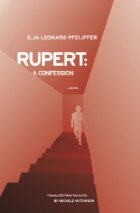
Review of Rupert: A Confession by Ilja Leonard Pfeijffer (translated by Michele Hutchison)

Rupert: A Confession
4.5 out of 5: In this novel by Ilja Leonard Pfeijffer, we learn immediately that Rupert has been accused of a horrible crime, but we know nothing of the specifics. The novel is structured as a confessional monologue, and Rupert begins his defense for the jury by describing the end of his relationship with Mira, his cherished lover. Emotionally devastated, Rupert wanders the city seeking satisfaction of his desires but finding only memories: “I sought her in vain in the mirrors and found instead the twinkling emptiness of memory and longing.”

Like an expert performer, Rupert maintains a taut suspense by slowly revealing, sometimes consciously and sometimes unconsciously, the important details of his story. His monologue is littered with early, subtle signs of his lunacy, such as his explanation of why he's an expert at all martial arts after only "a couple of lessons": "Those born to the Path see through the principles of every martial art and assimilate them into their soul without having to get bogged down in the details of the particular techniques." Delusional, surely, but also quite humorous. As the monologue progresses, the humor subsides, and Rupert’s delusions become ever more menacing. Rupert constantly plays with the distinctions between performers and audience, exhibitionists and voyeurs. Eventually, like many violent criminals, Rupert views himself as existing outside of his body and its actions; he becomes "the voyeur of his own exhibitionism."

Pfeijffer’s lyrical prose shows heavy influences of Nabokov: “Mira, my sugar-sweet, shimmering Mira, my masochism, my martyrdom, light of my lips, lymph of my cyanic sadness, sea of my swan dive, salt on my howling wounds, wait for me and let me find you.” These lines (so beautifully translated by Michele Hutchinson) reveal the depth of Rupert’s obsession with Mira and hint at the trouble to come.

This masterfully constructed novel culminates in a scene that might be the most powerful description of a crime I’ve ever read. As to be expected with the stories of psychopaths, Rupert is sexually explicit and loaded with the worst kinds of violence. If that’s okay with you, this glimpse into the twisted mind of a criminal will blow you away.