Sunday, April 24, 2011

A Review of Beautiful & Pointless by David Orr

Beautiful & Pointless: A Guide to Modern Poetry

In honor of Poetry Month (April), here’s another piece on poetry:


Despite its subtitle, Beautiful & Pointless is not really a “guide” to modern poetry. I would call it more of a meditation. Orr, the poetry critic for the New York Times Book Review, doesn’t really explain the various poetic forms or the different methods for deconstructing and understanding a poem. He doesn’t give any helpful tips to the beginner for how to read and appreciate poetry. Instead, Orr describes his task as “try[ing] to give you a sense of what modern poets think about, how those poets talk about what they're thinking about, and most important, how an individual poetry reader relates to the art he usually likes, always loves, and is frequently annoyed by.”


Using many examples of contemporary poetry, Orr discusses how poets inject the personal into their poetry (and, just as importantly, how some poets avoid the personal altogether) and how poets address and respond to current politics through poetry. There’s a chapter on form, but its main point seems to be that contemporary poets feel free to bend the rules of form. Two chapters (titled “ambition” and “the fishbowl”) discuss the inner workings of the poetry world, from the aspirations of contemporary poets to their reactions to each other to the difficulty in getting poetry published these days, much less read. A regular reader of poetry will find much of interest in Beautiful & Pointless and is likely to discover even more reasons to love poetry. For the poetry novice, however, this book is not the best choice of a guide as it assumes a certain, not insignificant level of prior knowledge and appreciation. In the book’s last chapter, Orr attempts to identify what makes poetry (both in the writing and reading) worthwhile. He dismisses the predominant views (i.e. poetry’s special connection to language, to ourselves, or to our society/culture and concludes that “[p]oetry is a small, vulnerable human activity no better or more powerful than thousands of other small, vulnerable human activities” such as gardening or movie watching. In the end, Orr believes we read poetry simply because we love it: it “seems beautifully pointless, or pointlessly beautiful.”

Saturday, April 16, 2011

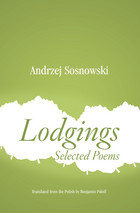
Lodgings by Andrzej Sosnowski (translated from the Polish by Benjamin Paloff)

Lodgings: Selected Poems 1987-2010
I'm certainly not qualified to review poetry, so this isn't a review, but I couldn't pass up the opportunity to tell you about Lodgings, the latest book published by Open Letter (one of my absolute favorite publishers). We are very lucky to get this opportunity to read Andrezej Sosnowski’s poetry in English. Lodgings in the first book-length collection of Sosnowski’s poetry to be translated into English from the Polish, and translator Benjamin Paloff has done a marvelous job capturing Sosnowski’s dream-like imagery and contrasting tones. This collection includes poems from nine of Sosnowski’s books, spanning more than twenty years of work (1987-2010).

Although I’m not an educated poetry critic, I am a longtime poetry appreciator. I know what I like, and Sosnowski’s poetry definitely qualifies. It’s challenging and often nonsensical on the first reading, but the lush imagery leaves me in a pleasant, rather than an annoying, fog of confusion. In each poem, I usually discover a line or two that really grabs my attention and encourages me to read the poem several times over so as to untangle its meaning. Meaning often shifts from line to line. These poems demand an open-minded and flexible reader.

To give you a sense of Sosnowski’s style (and Paloff’s translation), here are a couple of my favorite lines from two of the poems included in Lodgings.

From “Warsaw”:

Yesterday, after the paper, they were giving out a new hymn, actually /

a two-for-one mazurka and dream cake in chocolate sauce /

garnished with candied angelica, and today on the stairs and in the elevator /

the smell of mint chewing gum so that once again like the speech /

bubble in a comic strip it’s going to follow me all day.


From “Life in Korea”:

The intellect dozes a little, /

the senses have their turn, and again I’m seized /

by the lovely things of this world: apples, water, milk, /

purest air. And once you get it, /

that you haven’t earned these or any other /

fifteen minutes, you can have a drink, /

smash your world to pieces, and at long last /

think it over.

Tuesday, April 12, 2011

A Review of Open City by Teju Cole

Open City: A Novel
4 out of 5: From the very first paragraph, Teju Cole’s debut novel Open City announces itself as the tale of a wanderer:


And so when I began to go on evening walks last fall, I found Morningside Heights an easy place from which to set out into the city. … These walks, a counterpoint to my busy days at the hospital, steadily lengthened, taking me farther and farther afield each time, so that I often found myself at quite a distance from home late at night, and was compelled to return home by subway. In this way, at the beginning of the final year of my psychiatry fellowship, New York City worked itself into my life at walking pace.

As Julius, a Nigerian immigrant, meanders around Manhattan (and also around Brussels during a vacation trip), he ruminates on an astonishing array of topics. Chapter One touches on bird migrations, classical music radio programs, the art of listening, memory and the practice of memorizing, the failure of Tower Records and Blockbuster, and the recent death of a neighbor's wife. And that’s just the first chapter. Julius transitions from subject to subject effortlessly, if a bit randomly, reflecting on serious subjects as well as lighter ones. Like a cafe conversation with an intelligent and educated friend, nothing much happens in Open City and yet the book is never boring.


Julius’s sense of isolation permeates his thoughts, creating a somber tone for the novel, which is further compounded by recent events including the September 11th terrorist attacks and Julius’s breakup with his girlfriend. Residents and frequent visitors to New York City will recognize Julius’s path through that great city’s distinct neighborhoods, which he meticulously describes with street names, subway stops, and notable landmarks. Those without much experience or interest in the city may be bored by the specificity, but it’s easy enough to skim past these details. Overall, Open City is a thought-provoking meditation on the important (and some of the not so important) issues we all confront in contemporary America and Europe.

Monday, April 4, 2011

A Review of Solo by Rana Dasgupta

Solo
4 out of 5: Solo by Rana Dasgupta is a diptych of a novel composed of two related but independent halves. In the first half, a blind, 100-year-old Bulgarian man named Ulrich reminiscences about his life from the vantage point of his squalid apartment overlooking a train station in Sofia, the Bulgarian town in which Ulrich spent the vast majority of his life. Though graphically limited, Ulrich’s life touches many of the important moments in modern history, beginning with the last years of the Ottoman Empire and continuing through both World Wars, the Nazi and Russian occupations, post-war Communism, and eventually up to contemporary, independent Bulgaria.


Ulrich’s imaginative life is just as vivid as his actual life, and the second half of Solo is made up of Ulrich’s daydreams. Beginning as a series of distinct stories and characters, Ulrich’s daydreams become gradually more intricate and interrelated. Ulrich’s imaginative “children” include a young, ambitious Georgian woman and her shiftless brother, a Bulgarian musical prodigy, and an American executive of a record company. Their stories converge in contemporary New York City, where Ulrich inserts himself as a character in his own daydreams. In lush prose, Solo confronts the consequences of abandoned dreams and explores the relationship between life as it is lived in reality and as it unfolds in the imagination. Many of Ulrich’s creations stretch credulity (How does an elderly, blind Bulgarian man know about the internal politics at an American record company?), but these flights of fancy don’t detract from the overall effect. Ultimately, Solo suggests the life of the mind can be just as soul-sustaining as the life of day-to-day reality:

Thinking back, [Ulrich] is surprised at the quantity of time he spent in daydreams. His private fictions have sustained him from one day to the next, even as the world itself has become nonsense. It never occurred to him to consider that the greatest portion of his spirit might have been poured into this creation. But it is not a despairing conclusion. His daydreams were a life’s endeavor of sorts, and now, when everything else is cast off, they are still at hand.

Saturday, April 2, 2011

Do I Like Every Book I Read?

Some of you have noticed that the vast majority of my recent reviews have been favorable. Have I gone soft? No. I've just decided that, with the limited time I have, I'm not particularly interested in taking the time to write reviews for books I don't like. Although my reviews are generally short, each one takes at least an hour to write and most take several hours. I've got a substantial list of books I've read recently that I would rate no better than a 3.5 out of 5 (some would be 1/5 or 2/5). I keep meaning to write up a few of those reviews to mix in with my more favorable reviews, but since that task is so much less pleasant than writing a positive review of a book I'm excited to tell you about, I never seem to get around to it. For every review posted here at Literary License, there's at least one review (and often more) that never gets written. So, rest assured, I haven't lost my objectivity. I've just lost the motivation to tell you about books I don't like.